
The Ontario Lake Partner Program (LPP) has not yet released the Lakes’ testing data for 2024. Again, we thank the dedicated group of volunteers who conduct regular water quality testing at various key locations of our lakes, from May through September.
The LPP is a province-wide, volunteer-based, water-quality monitoring program. Volunteers collect total phosphorus samples in May and make monthly water clarity observations on their lakes. This information allows for the early detection of changes in the nutrient status and/or the water clarity of the lake due to the impacts of shoreline development, climate change and other stresses.
Why Sample?
High levels of phosphorus can lead to algal blooms and in some cases affect the habitat of cold water fish such as lake trout. By sampling the total phosphorus in May of each year it is possible to detect a change in the nutrient status of your lake. It is important to note that several years of data must be collected to observe the normal, between-year-differences before a trend can be identified.
While total phosphorus concentrations are the best way to describe the nutrient status of your lake, regular Secchi disk visibility depths can also help to identify changes in water clarity that are not linked to nutrient status (zebra mussels, climate change, etc.).
Secchi disk visibility readings are interpreted as follows (the higher the reading, the clearer the water):
High transparency (Secchi depth >4 m)
Moderately transparent (Secchi depth 2-4 m)
Low transparency (Secchi depth 0-2 m)
The Minimum Provincial Water Quality Objective (PWQO) is 2 metres, indicating that waters are usually clear and sufficient sunlight is able to penetrate the water column to support aquatic life. Typically, all test sites in Bobs and Crow Lake exceed this objective. The lowest average clarity depth in Bobs Lake on an annual basis are generally observed in Mill Bay, due in major part to the shallowness of the water level and higher nutrient levels.
The LPP Annual Report may be downloaded by visiting the FOCA website:
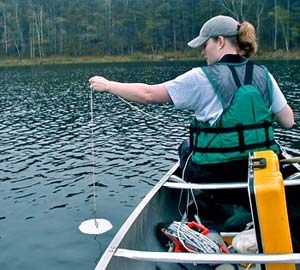
Volunteer performing a Secchi Disc water clarity test
Calcium and Zebra Mussels
Calcium, at a concentration of 20mg/l, allows zebra mussels to more likely establish colonies and complete their life cycle. Green Bay data indicates calcium levels exceeding 20mg/l. While calcium was below the threshold of 20 mg/l in all other bays as well as in Crow Lake, concentrations are close to meeting this point (>17mg/l).
Zebra mussels have well established colonies in Mud Bay, and have been at least observed in all other areas. Therefore, it is important property owners and users of the lake remain vigilant in protecting against the spread of this invasive species, particularly at public access points.
Boats, fishing gear, and other recreational equipment should always be cleaned and inspected before entering a different waterbody, to minimize the spread of invasive species. Drain water from the motor, live well, bilge and transom wells while on land. For more information please visit www.invadingspecies.com
RVCA Water Quality & E.Coli Testing
The Rideau Valley Conservation Authority (RVCA) once again conducted water clarity and E.Coli bacteria testing in 2024, as part of their Watershed Watch program.
Overall results for both lakes are good.
Great news, E. coli, which is used to assess the suitability for recreational use, was below the Provincial Water Quality Objective (PWQO) of 100 colony forming units per 100ml (CFU/100ml) maximum at all sites in both lakes.
Average nutrient parameters, total phosphorus (TP) and total Kjeldahl nitrogen (TKN) were below their respective PWQO maximum objectives of 20 ug/l (0.020 mg/l) and 500 ug/l (0.500 mg/l) at all sites. The highest average concentrations in Bobs Lake on an annual basis are generally observed in Mill Bay, due in major part to the shallowness of the water level.
For more information, see the RVCA Surface Water Quality website:
https://www.rvca.ca/docs-annual-reports/surface-water-quality-and-aquatic-habitat/viewdocument/512